
Almost everyone who wants to play a tabletop RPG and can't find a table ends up trying the same thing: opening a chat bot and typing "be my Game Master." The first twenty messages are genuinely enchanting. Then the potion count stops adding up, the goblin you killed walks back into the room, the dragon drops in a single blow because you insisted it should, and the game quietly turns into a collaborative writing session. This guide explains why that collapse is structural, exactly where it happens, and what actually fixes it. In one sentence: the AI narrates; the server decides the outcome.
What is an AI Game Master?
An AI Game Master is software that takes on both roles a tabletop RPG needs: narrator and referee. It describes the scene, gives the supporting cast a voice, assigns a difficulty to what you attempt, and writes the result of the dice back into the world. What separates it from a chat bot is that alongside the language model producing the prose, it runs a separate rules layer that holds the hit points, the inventory and the dice.
That "separate layer" clause looks like a boring technical detail, and it is the entire game. A language model predicts how a text should continue, and a good prediction picks what is dramatically right. Refereeing is the opposite job: saying no even when the dramatic answer is obvious, because the numbers don't support it. It might suit the story beautifully for the dragon to die on that line, but if its remaining hit points say otherwise, it doesn't die. These two jobs can't be settled inside one component, because that component ends up being both prosecutor and judge.
In practice, what you want from an AI Game Master is: a world that keeps going whatever you do, a ledger that doesn't forget (hit points, gold, inventory, quest step), a difficulty announced before the attempt and unchanged after it, and a pace where your decisions actually have consequences. The first of those is a job for language. The other three are not.
Game Master, Dungeon Master, or referee? The term we use in this guide
English has three words in circulation for the same person, so it's worth settling the choice up front and keeping it. Throughout this guide and every Thavernia guide the primary term is Game Master, shortened to GM, and the software version is the AI GM. The reasons are simple. Game Master is system-neutral: it works for a dungeon crawl, a court intrigue, a harbour-city mystery and a siege alike. It is also the term most tables reach for once they play more than one game.
"Dungeon Master" is the older and far more famous phrase, and if that's what your table says, nothing is wrong with it. It just carries two small problems: it belongs to one game's branded vocabulary, and it mis-describes a campaign that never sets foot in a dungeon. "Referee" is the oldest term of the three, inherited from wargaming and still alive in some indie systems; it's precise about the adjudication half of the job and silent about the storytelling half. People search using all three, so treat them as the same thing: the person who runs the table, describes the world and adjudicates the rules.
Three ways to play an RPG with AI (and who each one is for)
There are three routes, and the difference between them isn't "which AI is better", it's who keeps the rules. The short comparison:
- (A) A plain chat bot: Setup: none. Rules engine: none. Dice: the model invents them. Persistent ledger: none, only as far as the context window reaches. Good for: an evening of curiosity, a one-scene experiment.
- (B) Your own setup: Setup: hours. Rules engine: as much as you write yourself. Dice: real if you install a tool for it, invented if you don't. Persistent ledger: the note files you maintain by hand. Good for: the technically curious player who treats tinkering as part of the hobby.
- (C) A purpose-built RPG platform: Setup: minutes. Rules engine: built in and non-optional. Dice: generated server-side, thrown by you. Persistent ledger: a database. Good for: the player who wants to play rather than tinker, and to keep one campaign running for weeks.
The appeal of route (A) is obvious: you already have the account, you install nothing, you start in two sentences. And the first half hour really is good. The trouble starts after that half hour, and the whole of the next section is about it. For a full breakdown of this route, see playing D&D with ChatGPT.
Route (B) is, honestly, the most free of the three. You write the character sheets, you prune the system prompt however you like, you swap the model, you change the interface. No ready-made platform gives you that flexibility, and there's no point pretending otherwise. The cost is equally clear: what you've built is a toolkit, not a game. You have to find the dice tool, you have to keep the inventory, you have to repair it when something breaks, and in practice that maintenance can eat more hours per week than the playing does.
Route (C) inverts the trade: you give up the freedom to tinker and hand off the refereeing in return. Dice, damage, levels, inventory and quest steps are kept outside of you; when you sit down, the only thing you have to do is write what you want to do. Thavernia sits in this third category, and the concrete examples in this guide come from there.
Why does playing D&D with ChatGPT break after the first twenty messages?
It doesn't break all at once, it seeps, and by the time you notice, there's no going back, because the wrong numbers are already part of the story. There are five failure points. You can reproduce every one of them in your own chat in ten minutes; what follows is a description, not a quotation.
1. The model rolls the dice, then interprets its own roll. "I rolled a d20 and got 18" isn't a die roll; it's a guess about which number best fits the sentence. Easy to test: run the same scene five times in a row and look at how the numbers land at the critical moments. You'll see results pile up oddly high in dramatic beats and oddly average in trivial ones. The problem isn't cheating, nobody is cheating. The problem is that the narrator and the referee are the same component.
2. Nobody keeps the damage ledger, so hit points turn elastic. The enemy starts at 40 hit points, takes 55 damage over three turns, and is still standing; or the reverse, it drops because you wrote two good sentences. This isn't bad faith, it's the absence of a ledger. Numbers that appear inside the text are never added up outside the text. What the model is doing is writing a plausible answer to "how should this enemy be doing at this stage of the fight", and a plausible answer is usually reasonable, but it is never accounting.
3. Drift. The most common misunderstanding here: saying "the bot has no memory" is no longer true, memory is available to free users as well. But what memory holds is preferences, the tone you like, your character's name, the theme of the campaign. What it does not hold is the ledger: your hit points, your gold, the potions left in your pack, which step of the quest you're on, how many turns have passed. On top of that, long conversations get silently summarised, and numbers that fall outside the summary don't come back. The result: at message twenty the innkeeper's name changes, and at message thirty nobody remembers where the rope in your pack came from.
4. The yes-machine. Chat bots are tuned to be helpful, and in a Game Master that tuning becomes a defect: every plan works, every lie is swallowed, every door opens. Type "I persuade the guard" and the guard is persuaded. Five sessions in you realise you have never lost, and in a game where losing isn't possible, winning has no taste either. Tension comes from the capacity to say no.
5. The rules bend to whoever argues. Push back and the difficulty drops. Say "I don't think this should be that hard" and the model will usually agree with you. Worse is the retcon: "Actually, that dagger was already in your pack." Each of these concessions looks harmless on its own, but stacked up they leave the game with no state at all, only a world that the most recent sentence happens to remember.
Notice what all five have in common: none of them is about narrative quality. The description is lovely, the NPC dialogue is good, the pacing is right. What breaks is the refereeing. And refereeing can't be solved inside the prose.
What a real Game Master does: narrator versus referee
A GM's job splits in two. Narration: describing the scene, voicing the supporting cast, holding the pace, landing the surprise at the right moment. Refereeing: deciding how hard an action is, applying the die result impartially, keeping damage and hit points in a ledger, and applying a rule today the way it was applied yesterday.
Human GMs do both jobs inside one head, and the good ones have learned to keep them apart: rolling behind the screen, they apply what the die said rather than what the story wanted. They set the difficulty before the player attempts it, not after. That discipline is learnable precisely because a person can notice the moment their own preference and the rule disagree.
A language model can't notice that difference structurally, because to it both are one task: write the most likely continuation. "The hero succeeds at the critical moment" is, across the millions of stories in its training data, a statistically correct continuation. The model isn't cheating; it's obeying the grammar of stories. That's exactly the problem, the grammar of games is different. In a game, failure is a legitimate continuation.
Which brings us to the sentence this whole page rests on: the AI narrates; the server decides the outcome. Narration is a job for language, refereeing is a job for engineering. Splitting them isn't a design preference, it's a precondition for the game working at all. For a deeper dig into that argument, see is the AI Game Master fair?
Who rolls the dice? Server-authoritative two-phase dice
This is where the difference becomes concrete. In Thavernia the dice flow is split into two phases, and the order matters:
- 1. Plan. The Game Master calls for an ability check and states the difficulty in advance: which ability, what number, and why. "Agility check, difficulty 14, the tiles are wet."
- 2. Throw. The server generates the number and you throw the 3D d20 on screen. The number is fixed before the model ever sees it.
- 3. Resolution. The model learns the result and writes it into the narration. It doesn't pick the outcome, it interprets it. If a 7 comes up, you fall; describing how beautifully you fall is the model's job.
The importance of that ordering is this: the model only sees the number after it has been locked in. There is nowhere for the thought "an 18 would be lovely here" to enter. Number generation happens outside the narration, on the server; the model's job begins after the result exists.
At a multiplayer table the same flow is mirrored to the spectators: everyone sees live who rolled, which dice skin they used, and what came up. That keeps throws public rather than hidden, the oldest trust mechanism at any table is the die rolling out in the open.
Let's not overstate it: this arrangement makes the die result impartial, not the whole game flawless. The model can still overplay a result while interpreting it, or soften a scene more than it should. But the number itself isn't open to negotiation, and a number that can't be negotiated is the only solid ground the rest of the game can stand on.
Persistent world: why NPCs, quests and inventory don't disappear
While the narration flows, a ledger is kept behind it: supporting characters and their attitude toward you, open quests and their objectives, your inventory, your gold, your hit points, your progress through the level, the places you've visited. That ledger doesn't live in the conversation, it lives in a database, so however long the conversation gets, it isn't summarised away.
That alone isn't enough, though, because the lines that fill the ledger are still produced by the model. And the model sometimes writes the story and skips the structured part. It introduces the innkeeper you just met but drops the "new NPC" line; it describes a ring falling from the enemy but forgets the inventory line. A turn later, that ring doesn't exist.
So a second pass runs after every turn. It re-scans the turn's text, finds the things that happened in the story but never reached the ledger, and adds them. Two properties matter: it won't add the same thing twice (run it again and you don't end up with two rings), and it can only add, it has no authority to lower a boss's hit points, for instance. That way the recovery mechanism doesn't itself become an exploit.
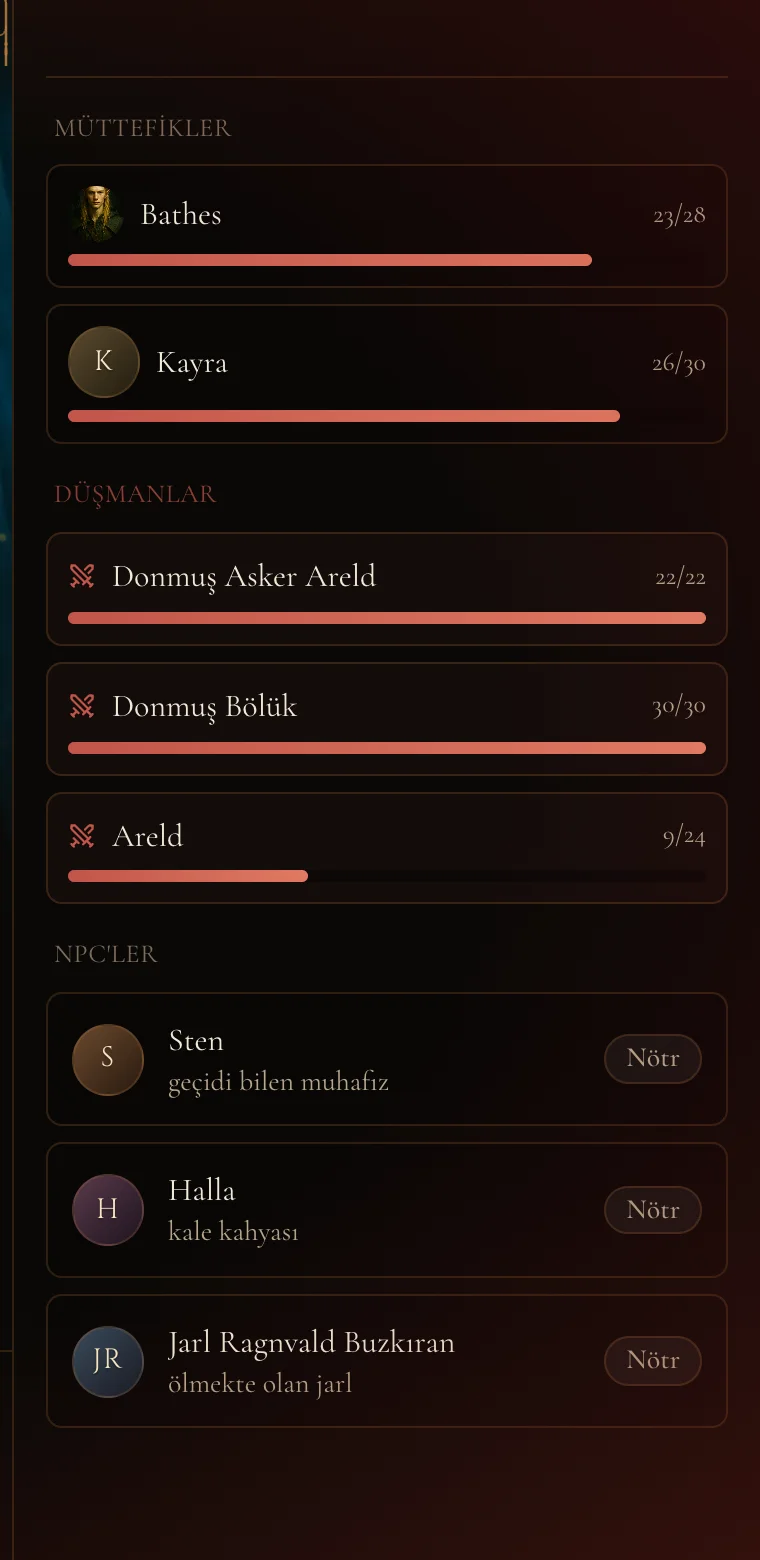
The practical upshot: in session fifteen the innkeeper's name is still the same, the merchant you angered in session three still looks at you sideways, and the potion count in your pack is exactly what you've spent it down to. These sound like small things, but keeping them straight is precisely what turns a series of scenes into a campaign.
There is one more layer: persistence does not stop at the campaign. Your hero's level, gold and inventory belong to the account, so they do not vanish when an adventure ends; they carry into the next one. Between adventures you return to town, take a fresh contract from the job board, craft at the workshops and talk to your companions. Items can be traded with other players or sold on the marketplace, which means what you win has both a history and a value.
Rules the AI cannot break
Moving the refereeing outside of language means concrete, countable rules. Four of them:
1. A ceiling on ability modifiers. However far an ability score is pumped, the modifier added to the die hits a ceiling: the classic +5 up to a score of 20, then +1 for every 4 points beyond, and a hard cap of +7 at 30. Why: so that a character who maxes one ability can't make the d20 meaningless and overshadow the rest of the game. Diminishing returns reward specialisation without making it unlimited.
2. The boss damage clamp. An enemy above a certain threshold (120 base hit points) counts as a boss, and the fight is divided into three hit-point phases. A single blow can't take more than roughly 10% of the boss's maximum hit points, with a floor of 15; on a natural 20 that rises to roughly 20%, with a floor of 25. Why: to make the "I dropped it in one hit" narrative impossible and turn a boss fight into something that genuinely lasts several turns.
3. A turn of misses does zero damage. If the party rolled attacks and every one of them missed, the boss takes no damage that turn, however kinetic the prose gets. Turns with no dice at all (a trap, a collapsing gallery, a beam coming down from the ceiling) still allow one blow's worth of damage, because hitting was never the question there.
4. A death the numbers don't support is refused. If the model writes that the boss dies while the ledger still shows hit points, the turn is rejected and rewritten. Friendly fire, on the other hand, is real: an attack inside the party comes off your friend's hit points, and characters can die.
How to play D&D with AI: your first session, in six steps
If you've never played, the first session takes fifteen minutes. The order goes like this:
1. Set up the campaign. Pick a theme and a tone (a grim harbour city, a classic dungeon, a court intrigue) and choose the narration language. The Game Master generates the opening scene and the campaign's cover art. These choices stick to the campaign; if you later want a completely different tone, starting a new campaign is cleaner than trying to bend this one.
2. Make your character. Ancestry, class, ability scores. If you don't know D&D, take one of the ready-made templates and move on, you'll learn what each score does in your first fight anyway. Just think about one thing up front: what does your character want? That's the thread the Game Master will pull on.
3. Write your first turn. Don't write long. One sentence of intent is enough: "I try to listen in on the man in the corner of the tavern." Describing the scene isn't your job; saying what you want to do is.
4. Throw the dice. When the Game Master calls for a check you see the difficulty, then you throw the d20 yourself. If the number is low, don't panic, failure isn't where the game ends, it's where the story turns. The best scenes usually come out of a roll of 6.
5. Look at the left panel. After the turn, that's where you see how the world changed: was a new NPC added, did a quest advance an objective, did your hit points drop, did something enter your inventory. Build the habit in session one; you'll be tracking the game from there for the next twenty sessions.
6. Continue, or invite someone to the table. The campaign is saved; you can close it and pick it up tomorrow. If you invite a friend, they play their own character, throw their own dice, and the world stays the same for both of you. You don't even need an account to try it: the free three-turn trial runs without one.
What should you write? Seven rules for a good turn
The single biggest factor in how good the game feels isn't the AI, it's how you write your turn. Seven rules, each with a bad and a good example:
- 1. Write your intent, not the outcome. Bad: "I kick the door in and drop the guard in one blow." Good: "I put my shoulder into the door; if it gives, I want to be the first one on the guard." The second leaves somewhere for a die to fall; the first leaves the Game Master nothing to do but agree.
- 2. Include the how: that's what lowers the difficulty. Bad: "I persuade the guard." Good: "I show the guard his captain's seal and try to look like I'm in a hurry, as if keeping me waiting is what gets him in trouble." A good 'how' is often worth more than a die roll.
- 3. Play what your character knows, not what you know. Bad: "It's a mimic, I don't touch it." Good: "The hinges on that chest are too clean; I prod the lid from a distance with a stick." Playing on meta knowledge kills the tension instantly.
- 4. One action per turn. Bad: "I open the door and search the room, then go out the window, climb to the roof and look over the city." Good: "I open the door and look the room over." Long chains turn narration into summary and take every decision in between out of your hands.
- 5. Don't negotiate after the difficulty is announced. Bad: "I don't think this should be 14, my character's a thief." Good: what you can still change when you hear the number is your plan: "14 is steep. Then instead of forcing the lock I'll try lifting the innkeeper's key." Change the approach, not the number.
- 6. Accept failure and play on top of it. Bad: "But I shouldn't have fallen." Good: "I fell, on the way down I try to catch the rope on the wall." The turns that grow out of failure become the most remembered scenes in a campaign.
- 7. Speak your dialogue in quotes. Bad: "I ask the innkeeper for a room." Good: "I turn to the innkeeper: 'A room for the night, one that faces the back. I'm leaving early.'" Direct speech visibly raises the quality of what the supporting cast gives you back.
[Intent] What I want to do, one action, and I don't write the outcome myself.
[How] The way I'm attempting it, what I have on me, what I'm counting on.
[Dialogue] If I'm speaking, my words in quotes, exactly as said.
[Limit] What I won't risk, "without making noise", "without killing anyone", "if the guards are many, I back off".

If you're using a plain chat bot instead of a purpose-built table, open the session with this line too: "Narrate in English. Before every check, tell me the ability and the difficulty number first. Never roll for me, ask me for the number, and use the one I give you. Keep a running list of my hit points, gold and inventory at the end of each reply."
You don't need to memorise the template; after two or three sessions it settles in by itself. The goal isn't to write long, a four-line turn works as well as a ten-line one, and usually better.
Playing in your language: written, not translated
Two different things get confused here. The first is interface translation: menus, buttons and settings are localised, but the story is conceived in one language and translated into another. You know the result when you see it, sentences that are grammatically fine but land oddly, idioms carried over word for word, characters who talk like a manual. The second is native narration: the system instructions, the terminology, the register and the supporting cast's dialogue are all produced directly in the language you're playing in.
In Thavernia the campaign's narration language is chosen at creation and is independent of the interface language: the menus can stay in one language while the story runs in another. The supported narration languages are English, Turkish, German, Italian, French and Spanish. The narration is generated directly in the language you picked; it isn't translated out of another one.
What that buys you in play is functional, not decorative. In a scene written natively, the innkeeper talks like an innkeeper does in that language: he clips his sentences, he needles you, he trails off. Register is the first thing a translation layer flattens, and it matters more than it sounds, half of tabletop roleplay is tone. It also means an English table gets English prose that was written as English, not English that arrived through a pipeline.
An honest note: house terminology varies between tables and between systems. "Saving throw", "advantage" and "proficiency" mean subtly different things depending on which game you grew up with, and an AI GM will use the flavour it was steered toward rather than the one your old group used. That's why this guide fixes its own terms up front, at minimum, to be consistent with itself.
Should you play solo, or with friends?
Most people arriving here are really saying "I can't find a table", so the two scenarios deserve separate treatment.
Playing solo, the table is you, the Game Master, and your AI companions. The companions aren't scenery: they have their own hit points, levels and decisions, they can object to your plan, they get hurt, they can die. That partly solves the classic problem of solo roleplay, what you actually lose playing alone isn't opposition, it's having nobody to argue with. Someone saying "I think that's a stupid idea" when you make a plan is half the game. Solo has its own advantages too: no calendar, nobody to wait for, and if you have half an hour at two in the morning you simply sit down and play, with the story revolving entirely around your character. For the full treatment, see solo tabletop RPG.
Playing with friends, the world is shared: an item one person finds, an enemy they kill, a merchant they annoy applies to everybody. Rolls are mirrored to the table, so everyone sees who threw what. Friendly fire being real adds its own flavour here, you think twice before letting off an area spell in a narrow corridor.
The real gain of group play is that it restores exactly what AI is worst at: the human energy at the table. The Game Master narrates, the server referees, and the jokes and stubbornness come from you. That three-way split is the most balanced table you can build with today's technology.
In practice the table works like this: your friends join through an invite link, every turn streams to everyone live, and you can talk over in-game voice chat if you want to. Open the table and someone who is not playing can follow along as a spectator. When a fight starts the table either moves to the tactical board, where the server computes reach, line of sight and range, or stays in narrative mode with no board at all, and which one suits your table is your call.
Will an AI Game Master replace a human one?
No. And expecting it to is the wrong question anyway. Most of what a good human GM does isn't refereeing, it's reading people.
What AI genuinely cannot do, stated without defensiveness:
- Read the people at the table: seeing who's bored, who's waiting for a scene, who's had a bad day, and bending the game accordingly.
- Carry a joke for six months. A human GM brings back an absurd throwaway line from session two in session twenty; that's what turns campaigns into memories.
- Bend a rule at the right moment. A good GM sometimes deliberately doesn't say no, because what the story needs right then isn't a rule. A written rules engine can't do that by definition.
- Long-arc dramatic pacing: deliberately slowing a three-session build, delaying a payoff, playing against the players' expectations.
- Building the table's own culture: the running jokes, the rituals, the snacks, and the real friendship between two of the players.
What an AI Game Master replaces isn't a good table; it's having no table. The real comparison isn't "AI or a human GM", it's "play with AI or don't play at all". Anyone who has tried to start a regular game knows how hard it is: five calendars never line up, nobody volunteers to run it, and the group dissolves by session three.
The two aren't rivals either. An AI GM is also useful as preparation for a human table: if you're going to run your own campaign you can rehearse a scene, try out an NPC's voice, or refresh the flow of the rules. If you have a table, keep it, if you don't, this is something you can put in the place of the months that go by empty.
Cost: playing on a chat subscription, or on a purpose-built platform?
Without quoting figures, let's describe the structure, because the real difference isn't the amount, it's what you're paying for.
(A) A chat bot subscription. You pay a flat monthly fee, setup costs nothing, and you may well have bought the subscription for other work already. In return you get no rules engine, no real dice and no persistent ledger; you're not paying extra for the game, but half the game is missing. If you try to play on a free tier, long sessions run into context and message limits.
(B) Your own setup. No flat subscription; instead you pay per token, for what you use. For a heavy player that can come out above or below a subscription, it depends entirely on session length and the model you choose, which is why nobody can honestly quote you a fixed figure. You also have to add the hours you'll spend on setup and maintenance; those hours don't appear on any invoice, and they're usually the most expensive line item.
(C) A purpose-built platform. You pay a flat monthly fee, and the rules engine, the dice infrastructure, the persistent world, the scene art, the voiced narration and the multiplayer table come inside it. What you're paying for isn't model access; it's refereeing and persistence. What you give up is the freedom to tinker, you can't rewrite the system prompt or reshape the rules to taste.
The decision rule is simple: if you'll play a couple of scenes a month, (A) is enough. If tinkering is part of the fun for you, (B) will give you more pleasure. If you want to run a regular weekly campaign and you're interested in playing rather than building, (C) makes sense. Don't decide without trying: the free three-turn trial exists for exactly that.
Glossary of tabletop terms (for newcomers)
- TTRPG: Tabletop roleplaying game; the international name for roleplaying games playable with pen, paper and dice, with or without a screen.
- Game Master (GM): The person who runs the table, describes the world and adjudicates the rules; also called Dungeon Master or referee.
- Player character (PC): The character a player plays and makes decisions for.
- Non-player character (NPC): Everyone else living in the world, run by the Game Master: the innkeeper, the guard, the dragon, the companion.
- Campaign: A long story continuing with the same characters across multiple sessions.
- Session: One sitting of play; the stretch from starting to the table breaking up.
- d20: The twenty-sided die; the success of most actions is decided by it.
- Ability check: Rolling a d20 and adding an ability modifier to measure whether an action succeeds.
- Difficulty Class (DC): The number a check has to reach to count as a success; the Game Master sets it before the roll.
- Modifier: The bonus or penalty added to the raw die, coming from your ability score, gear and situation.
- Natural 20 / natural 1: The die itself showing 20 or 1 before modifiers; the first means an exceptional success, the second a striking mishap.
- Hit points (HP): How much punishment a character or enemy can absorb; reaching zero means death or going down.
- Inventory: What a character carries: weapons, armour, potions, coin.
- Equipping (Actually wearing or wielding a weapon or piece of armour; having it in your pack isn't enough) it affects the story and the dice only once equipped.
- Boss: A large enemy with markedly high hit points whose fight is divided into phases.
- Friendly fire: An attack from one party member landing on their own ally.
What next: the Thavernia guides
This page was the introduction. Continue wherever you want to go deeper:
- The free three-turn trial: See the loop with your own hands, with no account and no card: intent, difficulty, dice, outcome.
- Playing D&D with ChatGPT: The full breakdown of playing with a chat bot: what it does well, and where and why it breaks.
- The AI Game Master: The page you're on: how narration and refereeing are separated, and what's inside the rules layer.
- Solo tabletop RPG: Ways to play alone, and what AI companions are actually for.
- Is the AI Game Master fair?: Dice generation, clamps, rejected turns, and the system's honest limits.
Frequently asked questions
Is playing D&D with AI free?
Partly. Trying it is: Thavernia gives you [three turns with no account](/trial), no card, no signup. Continuing beyond that needs a paid subscription. Playing with a chat bot isn't entirely free either: free tiers run into message and context limits during long sessions, and if you build your own setup you pay per token for API use.
Can I play without knowing the D&D rules?
Yes. The Game Master sets the difficulty itself and only asks you to write what you want to do; the system decides which ability applies and how many rolls it takes. When you make a character you can pick a ready-made template and move on. Rules knowledge deepens the game but isn't needed to start, the only thing you have to learn in session one is what the d20 is for.
Does the AI really roll dice, or does it make the number up?
In a plain chat bot it makes it up: "I rolled a d20 and got 18" is not a die roll, it's a probabilistic guess at the next piece of text. In Thavernia the server generates the number, you throw the 3D d20 on screen, and the model only learns the result after it exists. The model interprets the outcome; it doesn't choose it. The AI narrates; the server decides the outcome.
What language does the story come in, does it read like a translation?
The narration is written directly in the language you chose, not translated from another one. You pick the campaign's narration language when you create it, and that choice is independent of the interface language, the menus can stay in English while the story runs in German. Supported narration languages: English, Turkish, German, Italian, French and Spanish. The campaign's language is fixed at creation.
Is there any point in playing solo?
Yes, and it solves the classic problem of solo roleplay: playing alone, there's nobody to argue with. Here you have AI companions, characters with their own hit points, levels and decisions. They push back on your plan, sometimes go their own way, get hurt, and can die. A Game Master plus three companions is enough to fill a table of one.
Can my character actually die?
Yes. Death is a live possibility and friendly fire is real: an attack inside the party comes off your friend's hit points. That isn't there to be cruel, it's there so decisions carry weight. You set your own risk level, running, negotiating and retreating are always valid moves, and often the smartest ones.
Will an AI Game Master replace a human one?
No. A human GM reads the people at the table, opens a scene for the player who's gone quiet, carries a joke across a whole campaign, and bends a rule at exactly the right moment. AI is good at none of that. What it replaces is having no table at all: for someone who can't line up five calendars, can't find anyone willing to run a game, or has half an hour free at two in the morning, the alternative isn't a different game, it's not playing.
Can I invite friends into my campaign?
Yes, you can run a multiplayer table. Everyone plays their own character and throws their own dice, and the others watch that throw live, who rolled, which dice skin they used, and what came up all land on the table. World state is shared: an item one person finds, an enemy they kill and an NPC they anger apply to everyone.